Ministry of natural resources and environmental protection of the Republic of Belarus Map Republic

BELHYDROMET

Ru Be En
всв
youtube.com telegram viber instagram vk
  • About us
    • Structure
    • History
    • Periodicals
  • Activities
    • Agrohydrometeorology
    • Radiation and Ecology
    • Aviation weather reports
    • Scientific activity
  • Services
    • Requisites
  • Press center
    • News and events
  • Contacts
    • Guidance of Belhydromet
    • Reception
    • Office management department
  • youtube X facebook
  • Ru Be En
  • Блок 3 в 1
Main / Блок 3 в 1

Блок 3 в 1
20.02.2026
Honoring Young Talents: results of the International competition "Climate and water 2.0"
On February 20, 2026, an award ceremony for the winners of the International Research Competition for Students and Young Scientists in the field of Hydrometeorology "Climate and Water 2.0: Innovations and Digital Solutions" was held at the Belarusian State University (BSU) . The competition, organized by the BSU Faculty of Geography and Geoinformatics in partnership with Belgidromet, Roshydromet, the Russian State Hydrometeorological University, and Yugra State University, ran from May to December 2025. Its goal is to promote knowledge in climatology and hydrology, foster international cooperation, and identify talented youth. This year, the expert jury reviewed 80 papers from Belarus, Russia, Azerbaijan and Turkmenistan. The ceremony was attended by Sergei Khilman , Head of Belhydromet. His presence underscored the organization's commitment to supporting young professionals and developing cooperation with leading educational and research centers. The event began with a visit to the Museum of Earth Sciences, offering an opportunity to delve into the rich heritage of planetary study. The ceremony was opened by Elena Kolmakova , Dean of the Faculty of Geography and Geoinformatics at BSU, who noted the competition's importance in stimulating young people's research activities and forming a unified educational and informational environment. Mr. Khilman delivered a welcome address, emphasizing the relevance of the competition's theme in the context of modern challenges facing the hydrometeorological service. He commended the high level of the presented research projects and stressed the importance of involving young specialists in addressing pressing issues in hydrometeorology, particularly regarding digitalization and adaptation to climate change. The culmination of the day was the award ceremony for the competition winners. Young researchers who demonstrated deep knowledge and original ideas received well-deserved awards, serving as an incentive for the further development of their scientific talents. The competition "Climate and Water 2.0: Innovations and Digital Solutions" served not only as a platform for showcasing young people's scientific achievements but also as an important step in strengthening cooperation between science, education, and practice, laying the foundation for future innovations in the field of hydrometeorology.
10.02.2026
The Afghan echo in Belhydromet: memory and lessons
On February 10, 2026, a roundtable titled "Afghanistan in the lives of our compatriots" was held at the state institution "Republican Center for Hydrometeorology, Control of Radioactive Contamination and Environmental Monitoring." Eduard Novichkov, a direct participant in the fighting in Afghanistan , an employee of Belhydromet, shared his memories with the youth of Belhydromet. Thirty-seven years ago, on February 15, 1989 , one of the world's most combat-ready armies, having endured nearly ten years of fighting against well-trained mujahideen and mercenaries from over thirty countries, was withdrawn from Afghanistan. This day became the Day of Internationalist Warriors - honoring all who took part in military actions on the territories of other states. The date marking the beginning of the withdrawal of Soviet troops from Afghanistan is significant to all those touched by the breath of war in what was considered peacetime. It is a day of remembrance not only for those who fought in Afghanistan but for all internationalist warriors of the Limited Contingent of Soviet Forces in Afghanistan who participated in resolving military conflicts. The war in Afghanistan saw the participation of 28,832 citizens of Belarus. 771 were killed, over one and a half thousand were wounded, and 12 remain listed as missing in action. Eduard Novichkov spoke about the hardships of those times, noting that the Afghan war veterans honorably fulfilled their civic duty. "We must remember those of our contemporaries who passed through the fiery miles of war in what seemed to be peacetime, who live among us today, and those who are no longer with us, " he emphasized. Addressing the youth, Eduard Nikolaevich urged them not to forget the soldier, his loyalty to the military oath, his honor and courage, and his ability to prove himself a worthy successor to the combat traditions of his fathers and grandfathers in the most difficult situations. "Every war is a tragedy for the people. We must learn its lesson, remember the price we paid for the war in Afghanistan," he concluded. The event was accompanied by a presentation featuring photographs from those distant events. The Afghan War left a deep mark on history, reminding us of the need to preserve the memory of soldiers' honor, loyalty to their oath, and steadfastness.
06.02.2026
Preliminary assessment of the 2026 spring flood on rivers
The spring flood is an extremely complex multifactorial phenomenon determined by a whole complex of interconnected natural processes occurring over time. The main hydrometeorological factors influencing the formation of the spring flood are: - the amount of precipitation that fell during the autumn-winter period and during the flood formation period; - the water content (water equivalent) of the snow accumulated during the winter; - heat exchange, which determines the intensity of snowmelt; - the water absorption capacity of the basin, which depends on soil moisture in the autumn and the depth of soil freezing by the beginning of snowmelt; - river water levels/discharge. To date, the hydrometeorological conditions that will influence the spring flood this year have developed as follows: - the amount of precipitation that fell in the autumn and in December 2025 was within the norm; - the amount of precipitation in January 2026 was 120% of the climatic norm; - the water content in the snow within the river basins is significantly above the norm; - ice cover of thickness close to, and in some places slightly below, the norm has formed on rivers and water bodies; - the water levels/discharge of most rivers are close to the usual for this time of year, with only the Neman and Pripyat rivers having levels somewhat below the norm. Based on an analysis of the hydrometeorological conditions that have developed to date, it can be assumed that the maximum water levels of the spring flood will be close to or above the long-term average values. Water will reach the floodplain in almost all areas. The maximum water levels on most rivers will approach dangerously high marks, at which flooding of coastal areas is observed. During the river break-up, the movement of ice floes may lead to the formation of ice jams in narrow sections of river channels. Future weather conditions can either exacerbate the flood situation, in case of significant precipitation, or, conversely, mitigate it in case of a precipitation deficit, as well as a regime of positive air temperatures during the day and negative temperatures at night. When using the information a reference to Belhydromet is obligatory
05.02.2026
The final meeting of the labor collective was held at Belhydromet: a report on the work done and plans for the future
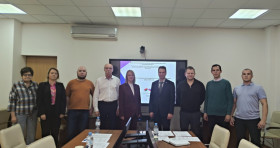
On December 5, 2026, the annual final meeting of the labor collective of Belhydromet took place, dedicated to summarizing the work for 2025 and defining tasks for the upcoming 2026. The event was attended by the management and employees of Belhydromet, as well as distinguished guests, including: Deputy Minister of Natural Resources and Environmental Protection of the Republic of Belarus Aleksei Stasyukevich ; Academician-Secretary of the Department of Physics, Mathematics and Informatics of the National Academy of Sciences of Belarus Aleksandr Shumilin ; Deputy Director for Scientific Work of the International Sakhalov Environmental  Institute State University Maria Germenchuk ; Head of the Department of General Earth Science and Hydrometeorology at the Faculty of Geography and Geoinformatics of the Belarusian State University Yuliya Gledko ; Head of the Department of Environmental Engineering at the Faculty of Mining and Environmental Engineering of the Belarusian National Technical University Anna Tsyganova . The meeting was opened by the Head of Belhydromet Sergei Khilman , who welcomed the participants and announced the official start of the event. Aleksei Stasyukevich addressed the audience with a welcoming speech, noting the importance of Belhydromet's work in ensuring the country's environmental security and sustainable economic development. Next, the Head of Belhydromet, Sergei Khilman , delivered a report on the results of Belhydromet's work in 2025. In his speech, he addressed personnel matters, the development of the hydrometeorological observation network and outlined key tasks for 2026. The First Deputy Head of Belhydromet, Tatsiana Chatyrka , presented a report on the results of the institution's work in 2025 in the areas of hydrometeorological, agrometeorological, scientific, aviation-meteorological and international activities. Deputy Head of Belhydromet Aliaksandr Trusov spoke about the results of work in the field of radiation monitoring, environmental monitoring and the provision of environmental information. Deputy Head of Belhydromet for Ideological Work Viktoria Nevodnichaya presented a report on the results of the ideological work carried out within the institution. During the meeting, the floor was given to invited guests, who shared their impressions of Belhydromet's work and expressed their wishes for the future. Summing up the meeting, Aleksei Stasyukevich and Sergei Khilman noted the high professionalism of the institution's employees and emphasized the importance of further development of the state hydrometeorological service for ensuring the country's sustainable development. The event concluded with an awards ceremony for employees based on the results of their work in 2025.
04.02.2026
How do cyclones get their names?
In the lowest layer of the atmosphere, the troposphere, atmospheric vortices are continuously born, develop, and disappear. Some are so small they escape our notice, while others are so large-scale that they significantly influence the Earth's climate and cannot be ignored (this primarily applies to cyclones and anticyclones). Cyclones are areas of low pressure in the Earth's atmosphere. A frequent companion of a cyclone is strong, gusty wind, arising from the difference in atmospheric pressure between the cyclone's center and its periphery. Cyclones (from the Greek for "coil of a snake") are enormous vortices, up to several thousand kilometers in diameter. They form in temperate and polar latitudes when warm air masses from the equator collide with cold flows from the Arctic (Antarctica), creating an atmospheric front. So, why are cyclones given names? To avoid confusion when warning the population about approaching typhoons and hurricanes in tropical latitudes. Several cyclones can exist simultaneously in one region, so it is necessary to distinguish between them. A name attracts attention and increases vigilance. The first attempts to name hurricanes were made in the 19th century in the Caribbean Sea , naming them after saints on whose feast day the disaster struck. In the early 20th century, Australian meteorologist Clement Wragge named them after mythical heroes, and then after parliamentarians who refused to vote for credits for meteorological research. During World War II , American military meteorologists in the Pacific region named typhoons after their wives and girlfriends. After the war, alphabetical lists of female names were compiled, and in 1979, the WMO expanded the lists to include male names. Names are used on a rotating basis, but if a typhoon is particularly destructive, its name is retired from the list. Europeans adopted this practice, and now one can even become the "godparent" of a cyclone or anticyclone for a fee. The copyright for this belongs to the Department of Meteorology at the Free University of Berlin. For a certain sum, one can become the "godparent" of a particular atmospheric vortex. Over time, the practice of assigning names became a standard procedure in world meteorology. Each region uses its own lists of names, developed by the WMO. In Japan, hurricanes are named after animals, flowers, trees, and foods, to avoid associating destructive typhoons with gentle female names. Tropical storms in the Indian Ocean often remain nameless. Prepared based on materials from the staff of the "Vitebskoblhydromet" branch. When using the information a reference to Belhydromet is obligatory
03.02.2026
A reporting meeting was held at the "Brestoblhydromet" branch under the leadership of Sergei Khilman
Today, a meeting was held at the "Brestoblhydromet" branch to summarize the work results for 2025 and set tasks for 2026. The event, led by the Head of Belhydromet , Sergei Khilman , was attended by representatives from various departments and organizations of the Brest region. Among the honored guests were Alexander Polkhovsky, Head of the Department of the Brest Regional Department of the Ministry of Emergency Situations; Yuri Roy, Head of the Department of the "Belovezhskaya Pushcha" National Park; representatives of higher educational institutions in the city of Brest; as well as heads of structural and separate subdivisions of the branch. The Head of the branch, Andrei Kulchik, delivered a detailed report on the results of the past year, covering all areas of the branch's activities. Special attention was paid to problematic issues and tasks facing the team in 2026. During the meeting, issues related to conducting meteorological, aerological, actinometric, and hydrological observations; atmospheric air monitoring; cooperation with the Ministry of Emergency Situations during the spring flood period; modernization of the hydrometeorological network; technical support for subdivisions; and the prospective construction of a weather station in the Belovezhskaya Pushcha territory were discussed. In conclusion, Sergei Khilman emphasized the importance of timely dissemination of hydrometeorological information through the media, the necessity of meeting planned targets, and thanked the branch's team for the work done. The best employees of the "Brestoblhydromet" branch were awarded for their contribution to the development of the hydrometeorological service.
03.02.2026
Information on the hydrometeorological situation in the river basins of the Republic of Belarus, as of January 2026
The average air temperature in January 2026 was -10.3 °C, which is 6.2 °C below the climatic norm. All three decades of the month were cold. The coldest was the second decade, with an average temperature 12.0 °C below the norm. The temperatures of the first and third decades were below the norm by 2.0 °C and 4.7 °C, respectively. During the month, an average of 49 mm of precipitation fell in the republic, which was 120% of the climatic norm. Precipitation was distributed unevenly across the country's territory, with most areas receiving 90-150% of the monthly norm. Precipitation was uneven throughout the month. The first decade saw excessive moisture (253% of the norm). The second decade experienced a precipitation deficit (16% of the norm). In the third decade, an average of 89% of the norm fell across the country. Precipitation fell as snow and sleet. Snow cover persisted throughout the entire month. According to snow survey data along a field route on January 31, snow depth in Belarus ranged from 9 cm to 51 cm, with a water reserve of up to 130 mm. In the territory of the Russian Federation (in the upper reaches of the Western Dvina, Dnieper, and Sozh rivers), snow depth ranged from 29 cm to 57 cm, with a water reserve of up to 150 mm. In January, frosty weather contributed to intensified ice formation processes . By the end of the second decade, ice cover (complete ice cover or with polynyas) had become established almost everywhere on the country's water bodies. Subsequently, ice thickness increased. On the last day of January, the thickness of the ice cover was up to 31 cm on rivers, up to 52 cm on reservoirs, which is close to normal and slightly lower her.  Fluctuations in river water levels were observed, more pronounced in the first decade (up to 40 cm per day) due to ice jams. The water content (discharge) of most rivers was close to the usual for this season, with only the Neman and Pripyat rivers having somewhat below-normal water content. When using the information a reference to Belhydromet is obligatory
03.02.2026
Why does the air feel dirtier in winter? We understand the reasons
Winter is a time when we often notice the air becoming denser, harder to breathe, and visibility worsening. These aren't just our perceptions, but a real phenomenon linked to a combination of factors. During the winter period, an anticyclone – an area of high atmospheric pressure characterized by weak or absent winds – often settles in. When there is no wind, emissions from transport, industrial plants, and heating systems remain "trapped" in the ground layer of the atmosphere. The heating season also noticeably increases during the cold period, leading to greater emissions of pollutants. However, the main culprit for the deterioration of air quality in winter remains transportation. In cold weather, internal combustion engines operate less efficiently. Warming them up requires more fuel, and the combustion process can be incomplete, leading to increased emissions of carbon monoxide, hydrocarbons, and particulate matter. Tire wear on slippery roads also produces fine rubber dust. And the reagents used on roads to combat ice can, upon interaction with exhaust gases and moisture, form new, more toxic compounds. Combating winter air pollution requires a comprehensive approach. At the state level, this includes tightening environmental standards for industrial enterprises and transport, incentivizing the transition to cleaner fuels, and developing renewable energy sources. Implementing modern emission purification systems at boiler houses and factories, as well as developing "green" infrastructure in cities, such as parks and green spaces, can significantly improve air quality. Information prepared based on materials from the website of the "Grodnooblhydromet" branch .
02.02.2026
Daily temperature minimums updated in Belarus
On February 2 , daily minimum air temperature records were broken at several weather stations at once. At the Vysokoye meteorological station (hereinafter - MS), the thermometer dropped to -24.2℃ , which is lower than the previous record from 2012 (-23.8℃). At MS Stolbtsy, -26.9℃ was recorded (the previous record, also from 2012, was -25.1℃). At MS Gantsevichi , the temperature reached -28.9℃ (compared to -27.4℃ in 2012). In Oshmyany , -27.8℃ was recorded (the previous record was -27.7℃ in 2012). The lowest temperature on February 2 was registered at MS Polesye – -31.1℃ , which is significantly lower than the previous record from 2012 (-27.8℃). It should be noted that the absolute minimum air temperature for February 2 was recorded in 1970 at the Grodno Automated Meteorological and Geophysical Station (AMGS) (-33.4℃) . In addition, on February 1, a daily record was broken at the Mstislavl weather station, where the temperature dropped to -23.8℃ (the previous record from 2012 was -22.8℃). It is important to note that the Mstislavl station has been conducting observations since 2008. When using the information a reference to Belhydromet is obligatory
22.01.2026
Belhydromet invites you to an Open Doors Day!
Dear residents and guests of the capital! The Republican Center for Hydrometeorology, Control of Radioactive Contamination and Environmental Monitoring (Belhydromet) invites you to an Open Doors Day to be held on January 23, 2026. On this significant day, you will have a unique opportunity to look behind the scenes of one of the most important environmental organizations in the country. You will learn how weather observations are conducted, how forecasts are made, and how the state of the environment in Belarus is monitored. The Open Doors Day at Belhydromet is a great opportunity to get reliable first–hand information, broaden your horizons and learn more about the importance of the hydrometeorological service for our country. We invite everyone! For inquiries, please call: 80297004571 from 8.30 to 17.00
1 2 3 4 5 6 7 8 9 10 [11..11]

Specialized sites

Pogoda.by Rad.org.by nsmos.by

Informational resources

000120_eb96852ad10b0f40634fc2ac807a208a_work.jpg State Symbols of the Republic of Belarus 000120_cffd213c635e16631680b72b64785b72_work.jpg The National Legal Internet Portal of the Republic of Belarus 000120_8c3bdf6e7574e3150a94810421a74e17_work.jpg The Ministry of Natural Resources and Environmental Protection of the Republic of Belarus 000120_e961c7bafa7862b6ec792000d417d43c_work.jpg The Official Internet Portal of the President of the Republic of Belarus 000120_d4ccbc92a75822a04d9443d206470042_work.jpg The Portal for Rating Assessment of the Quality of Services Provided by Organizations in the Republic of Belarus 000120_60625fb4d7255be81a7d6a4f54391049_work.jpg The CIS Interstate Council for Hydrometeorology (CIS ICH) 000120_2cf03b5ed9cfd948ec67d2edb868ce8b_work.jpg Information Analysis Portal of the Union State 000120_e42220828207561fd3ae263681478868_work.jpg The Union State Committee on Hydrometeorology and Environmental Contamination Monitoring 000120_a48c08245f74d0ff95dbd0e558f8b0be_work.jpg The Internet Portal "The Youth of Belarus"
Cookies are used to ensure the user-friendliness of the site

More details
Accept
Decline

About us

  • Structure
  • History
  • Periodicals

Activities

  • Agrohydrometeorology
  • Radiation and Ecology
  • Aviation weather reports
  • Scientific activity

Services

  • Requisites

Press center

  • News and events

Contacts

  • Address: 110, Nezavisimosti Avenue, Minsk, 220114
  • Phone:  +375 17 373-22-31
  • E-mail: kanc@hmc.by
  • Opening hours:
  • Monday-Friday:
    9.00-18.00
  • Days off: Saturday, Sunday
  • x ok facebook

© Belhydromet, 2016-2026