


40 years since the Chernobyl accident
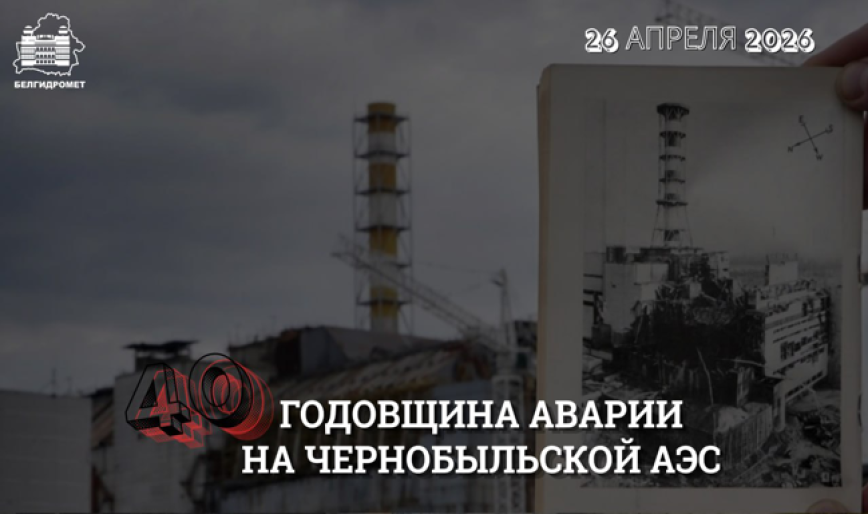
On April 26, 2026, it will be 40 years since the accident at the Chernobyl Nuclear Power Plant.
This date is not only an occasion to remember the events of 1986 but also an opportunity to assess the work carried out to minimize the consequences of radioactive contamination of territories, as well as to emphasize the importance of continuous monitoring of the radiation situation for the timely warning of government authorities and the public to enable prompt protective measures.
From the very first days after the accident, specialists of Belhydromet took part in assessing the radiation situation. Efficiency, professionalism, and a willingness for self-sacrifice became the key traits of those who found themselves on the front line of the fight against an invisible threat.
Anatoly Polishchuk, a veteran of the Chernobyl accident cleanup, former Head of Belhydromet, and a veteran of the State Hydrometeorological Service of the Republic of Belarus, who was working in Mogilev at the time, recalled: "In 1986, our hydrometeorological department honorably fulfilled its duty to the Motherland — including measuring the gamma background exposure dose rate." As early as April 27, instructions were received to switch to hourly observations, and all weather stations immediately joined the effort.
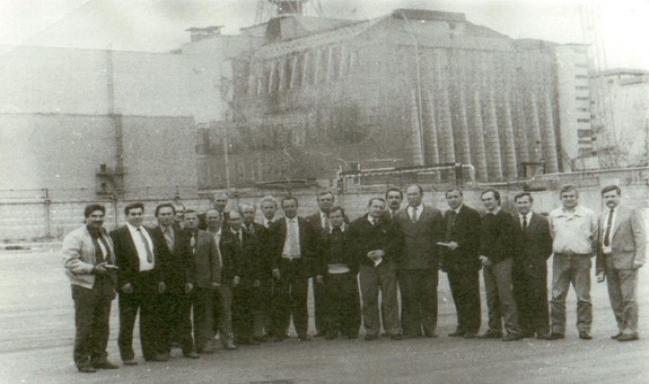
Liquidators from Mogilev region near the destroyed Chernobyl reactor
Viktor Melnik, a Chernobyl accident cleanup veteran, former Deputy Head of Belhydromet, shared his memories of that time: "The hydrometeorological service worked coherently, in an organized and professional manner — as befits true patriots ready to defend their land." Specialists worked in the 30‑kilometer zone and directly in Chernobyl, compiling detailed contamination maps. These maps became the basis for decisions on resettlement zones, public protection measures, and plans for managing the consequences of the accident.
Helicopter surveys played a particularly important role. Vyacheslav Parfenov, a Chernobyl cleanup veteran and Head of the Land Monitoring Department of the Environmental Monitoring Service at Belhydromet, described how he and his colleagues measured gamma background levels in dozens of settlements, sometimes at great personal risk: "The pilots showed true skill, maneuvering between houses and trees, while local residents greeted them with hope and trust. For them, our helicopters were a symbol that they were not forgotten and that everything possible was being done to help."
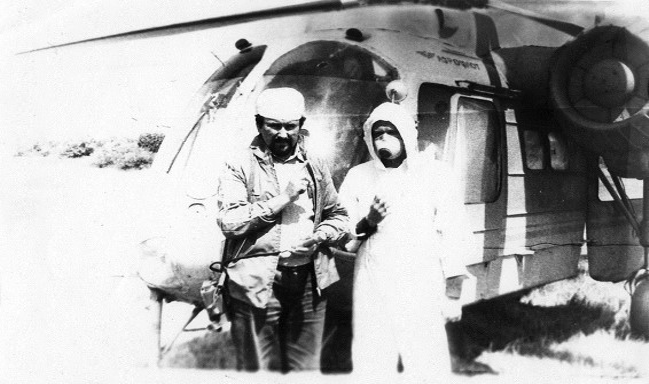
Flights into the zone
Olga Zhukova, a Chernobyl cleanup veteran, former Head of the Department for Scientific and Methodological Support of Radiation‑Environmental Observations at Belhydromet, who took part in expeditions to the exclusion zone, spoke about working in the "Red Forest" — an area that absorbed one of the most intense radiation strikes: "The dosimeters were off the scale, but we continued to do our duty. Every measurement, every sample was critically important. We understood: people's lives depended on the accuracy of our data."
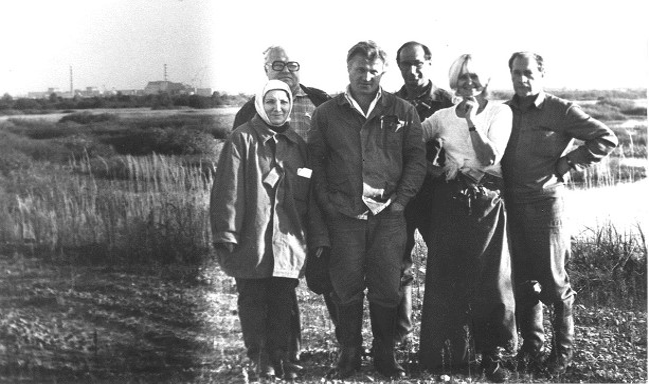
Expedition participants in the floodplain of the Pripyat River (10‑km zone of the Chernobyl NPP, Ukraine) near the Red Forest"
Vladimir Samsonov, a Chernobyl cleanup veteran and Head of the Radiospectrometry Department of the Radiation Monitoring Service at Belhydromet, shared how their research helped prevent the re‑evacuation of people to hazardous areas: "We were able to prove that radiation levels in some places were still too high. This allowed us to avoid new tragedies and preserve the health of hundreds of families."
Today, 40 years later, the service continues to conduct continuous monitoring of the radiation situation throughout the entire territory of the country.
Key areas of Belhydromet's work in the context of Chernobyl's legacy:
- conducting online radiation monitoring using automatic measurement points of the automated system for radiation monitoring. Every 10 minutes, gamma radiation dose rate measurements are transmitted to Belhydromet, where they are monitored around the clock by specialists from the Operational Radiation Control Data Department.
- monitoring radionuclide content in ambient air. Determining the radiation characteristics of radioactive fallout and near‑surface atmospheric aerosols is primarily aimed at detecting short‑lived anthropogenic radionuclides, which serve as indicators of an accident at nuclear or radiation‑hazardous facilities.
- research on cesium‑137 and strontium content in soil enables assessment of radioactive contamination density in territories and monitoring of radionuclide migration, as well as monitoring of surface and groundwater to assess annual average concentrations of radionuclides in water and bottom sediments.
- Belhydromet provides access to up‑to‑date radiation situation data via its official website: https://rad.org.by.
- the use of modern hardware‑software complexes that allow modeling the spread of radioactive contamination in the environment over time and space, taking into account meteorological conditions.
The Chernobyl accident was a lesson for the entire world. The Republic of Belarus, more than any other country, has learned its main lessons:
- the need for strict compliance with nuclear and radiation safety standards at nuclear energy facilities.
- the importance of international cooperation on radiation safety matters.
- the critical role of environmental radiation monitoring.
- information transparency regarding radiation monitoring results, as well as the need to educate the public on radiation safety matters.
When using the information a reference to Belhydromet is obligatory
Specialized sites
Informational resources
 State Symbols of the Republic of Belarus
 The National Legal Internet Portal of the Republic of Belarus
 The Ministry of Natural Resources and Environmental Protection of the Republic of Belarus
 The Official Internet Portal of the President of the Republic of Belarus
 The Portal for Rating Assessment of the Quality of Services Provided by Organizations in the Republic of Belarus
 The CIS Interstate Council for Hydrometeorology (CIS ICH)
 Information Analysis Portal of the Union State
 The Union State Committee on Hydrometeorology and Environmental Contamination Monitoring
 The Internet Portal "The Youth of Belarus"