


40 years after Chernobyl: Belhydromet at the International conference "40 Years After Chernobyl: The Results"
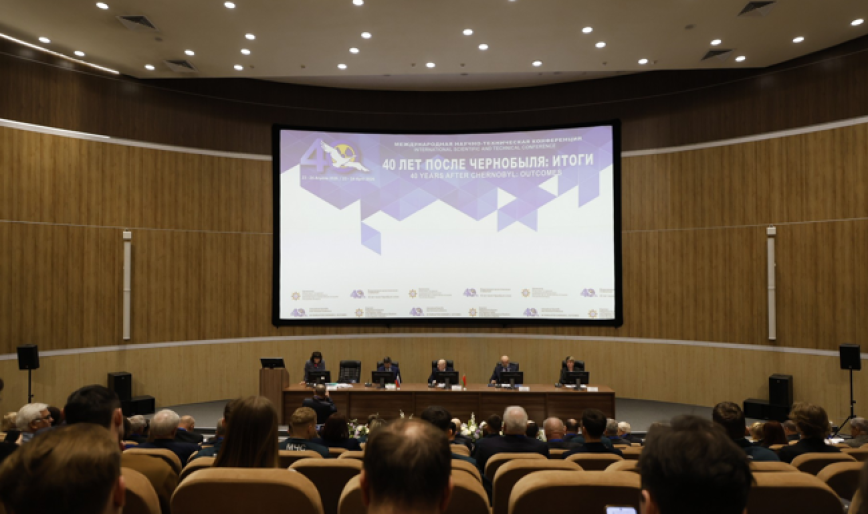
On April 24, the International Scientific and Technical Conference "40 Years After Chernobyl: The Results" was held at the Educational Center for Life Safety of the Ministry of Emergency Situations.
The event, dedicated to the 40th anniversary of the Chernobyl nuclear power plant accident, brought together leading experts, scientists and government officials from Belarus and the Russian Federation. Participants conducted a comprehensive analysis of the experience accumulated over these years and identified further prospects for the rehabilitation and development of the affected territories.
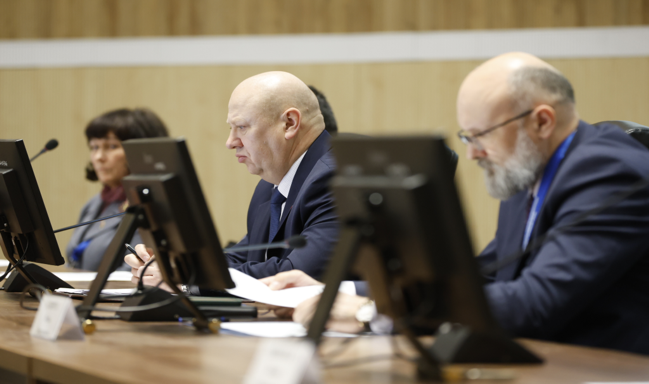
The conference was attended by representatives of various ministries and departments of Belarus and Russia directly involved in mitigating the consequences of the Chernobyl accident. Key participants included Zhanna Chernyavskaya, Chairperson of the Standing Commission on Ecology and Nature Management of the House of Representatives of the National Assembly of the Republic of Belarus; Academician of the National Academy of Sciences of Belarus Iosif Bogdevich; Professor Tatiana Marchenko of the All-Russian Research Institute for Civil Defense and Emergency Situations of the Russian Ministry of Emergency Situations; and Igor Sekret, Deputy Minister of Foreign Affairs of the Republic of Belarus.
Deputy Minister of Emergency Situations Sergey Salanovich emphasized the significant amount of work carried out by Belarus to rehabilitate and return the territories affected by the accident to safe economic use. He noted that over four decades, an effective emergency preparedness and response system has been established, and comprehensive, systematic work has created conditions for safe living and economic activity.
"Modern Belarus is a unique source of knowledge and practical experience in overcoming the consequences of the Chernobyl accident," said S.Salanovich, highlighting successes in ecosystem rehabilitation, socio-economic recovery, and long-term planning. He assured that the radiation safety of the population has been ensured, a multi-level specialist training system has been established, a set of protective measures is implemented on an ongoing basis, and social protection for citizens is at an adequate level.
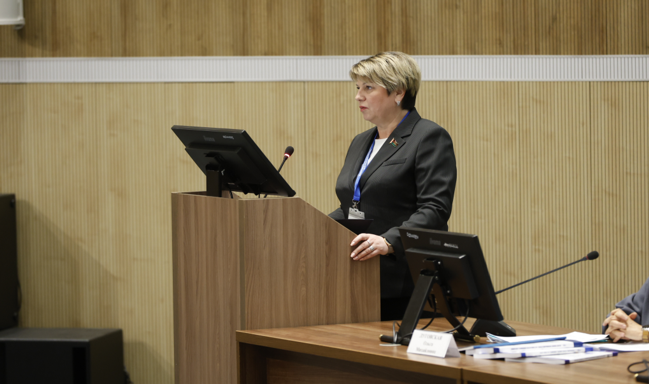
Zhanna Chernyavskaya, Chairperson of the Standing Commission on Ecology and Nature Management of the House of Representatives of the National Assembly of the Republic of Belarus, highlighted the importance of joint work by experts and scientists to develop a strategy for managing the post-Chernobyl situation. She mentioned the implementation of six state programs in Belarus and five Union State programs aimed at comprehensively solving the problems of the affected territories. Plans for the next five-year period include measures for public safety, the introduction of new technologies for medical care and protection of the forest fund from fires.
The conference addressed the following key areas:
- systematic socio-economic rehabilitation of affected regions;
- current status and prospects in the development and production of nuclear-physical equipment;
- experience in public information regarding the mitigation of the Chernobyl accident.
Oleh Dziubailo, Head of the Radiation Monitoring Service of Belhydromet, presented a report entitled "The Radiation Monitoring System and Control of Settlements and Facilities on the Territory of the Republic of Belarus."
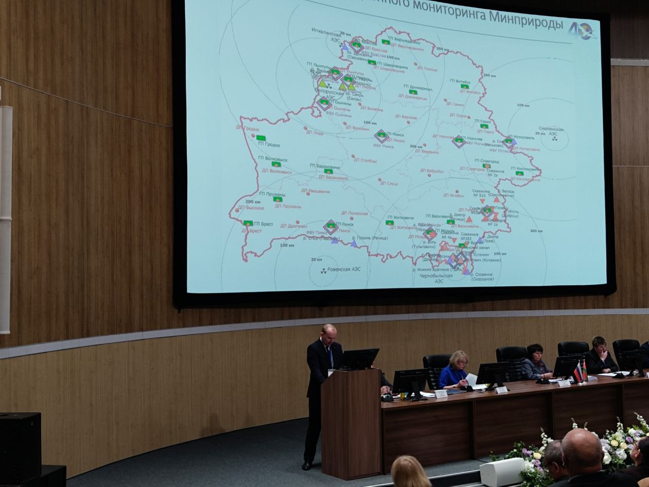
He emphasized that the modern monitoring system is the result of half a century of development, but the 1986 Chernobyl accident was the catalyst for its large-scale improvement.
"The radiation monitoring network available by 1986 made it possible to assess the dynamics of gamma radiation dose rate levels and the concentration of iodine-131 and cesium-137 in the air in the first days after the accident," noted Oleh Dziubailo. However, the aftermath of the accident required the expansion of observations, including not only atmospheric air but also surface water, groundwater and soil. Large-scale surveys of territories were organized, and a network of reference sites and landscape-geochemical polygons was established.
Today, 40 years later, the radiation situation in Belarus is stable and predictable. There is a steady reduction in radiation doses due to natural processes and targeted human activity. Consequently, since 2012, the radiation monitoring system has undergone optimization phases. The list of observation points in the area of the Belarusian NPP was expanded to include monitoring points for radioactive fallout, aerosols, surface water, and soil. The observation network around the Belarusian NPP is configured for use at all stages of its life cycle.
Radiation monitoring in the Republic of Belarus is carried out in accordance with the Laws "On Radiation Safety" and "On the Legal Regime of Territories Contaminated with Radioactivity as a Result of the Chernobyl NPP Catastrophe," as well as the relevant Regulation of the Council of Ministers. The country operates 120 radiation monitoring observation points covering atmospheric air, soil, surface water, and groundwater.
Observations are conducted for natural background radiation, the impact of potential sources of radioactive contamination (including transboundary transport), and for assessing radioactive contamination in areas affected by the Chernobyl NPP accident.
Atmospheric air: at 41 observation points, gamma radiation dose rate is monitored (daily); at 25 natural fallout observation points and 10 radioactive aerosol observation points, total beta activity, activity of gamma-emitting radionuclides (cesium-137, beryllium-7, lead-210), and strontium-90 are measured.
Soil: a network of 52 observation points (reference sites and landscape-geochemical polygons) allows for the assessment of gamma radiation dose rate and the activity of cesium-137 and strontium-90. Sampling is carried out periodically, with greater frequency at observation points near the Belarusian NPP and within the PGRERZ (Polesie State Radiation-Ecological Reserve).
Surface water: at 19 observation points, including major rivers, transboundary sections, and water bodies in the NPP influence zone, monitoring of total alpha and beta activity, activity of cesium-137, and strontium-90 is conducted. Bottom sediments are also studied.
Groundwater: at 6 observation points, total alpha and beta activity as well as the content of cesium-137 and strontium-90 are controlled.
The Chernobyl accident stimulated the creation of an automated system for monitoring the radiation situation (ASMRS) in the influence zones of NPPs. Currently, the ASMRS includes 23 automated measuring points (AMPs) in the influence zones of NPPs in neighboring states and 10 AMPs in the influence zone of the Belarusian NPP, providing continuous monitoring.
The Information and Analytical Center for Radiation Monitoring of Belhydromet collects, stores, and processes data. The RECASS NT hardware-software complex, capable of modeling accident scenarios and their environmental consequences, is used to forecast the spread of radioactive contamination.
During the observation period following the Chernobyl NPP accident, three cases of increased levels of atmospheric radioactive contamination have been recorded, related to the Fukushima NPP accident, fires in the Chernobyl exclusion zone, and an unknown source (ruthenium-106). In all cases, the calculated radiation doses did not pose a threat to public health.
Belhydromet actively participates in preparing the List of Settlements and Facilities located in radioactive contamination zones and in updating radiation situation maps. Over 40 years, 1,491 settlements have been removed from radioactive contamination zones.
Belhydromet's modern radiation monitoring system provides timely information to the public and relevant authorities via web resources (rad.org.by, nsmos.by) and the mobile application "Weather in Your Pocket." This confirms Belarus's high level of preparedness for managing the post-Chernobyl situation and ensuring radiation safety.
The International Scientific and Technical Conference "40 Years After Chernobyl: The Results" served as an important platform for reflecting on the path traveled, sharing knowledge, and developing effective solutions aimed at building a safer future.
The information was prepared based on materials from the website of the Ministry of Emergency Situations of the Republic of Belarus and the report of Oleh Dziubailo, Head of the Radiation Monitoring Service of Belhydromet.
Specialized sites
Informational resources
 State Symbols of the Republic of Belarus
 The National Legal Internet Portal of the Republic of Belarus
 The Ministry of Natural Resources and Environmental Protection of the Republic of Belarus
 The Official Internet Portal of the President of the Republic of Belarus
 The Portal for Rating Assessment of the Quality of Services Provided by Organizations in the Republic of Belarus
 The CIS Interstate Council for Hydrometeorology (CIS ICH)
 Information Analysis Portal of the Union State
 The Union State Committee on Hydrometeorology and Environmental Contamination Monitoring
 The Internet Portal "The Youth of Belarus"