


Climatic characteristics of the spring season of 2026
The average air temperature in the spring season of 2026 was +8.8 °C, which is 1.5 °C above the climatic norm. Over the entire period of instrumental observations, beginning in 1881, such a warm spring occurs on average once every 18 years. The warmest spring was that of the distant year 1921, with a seasonal average air temperature of +10.3 °C.
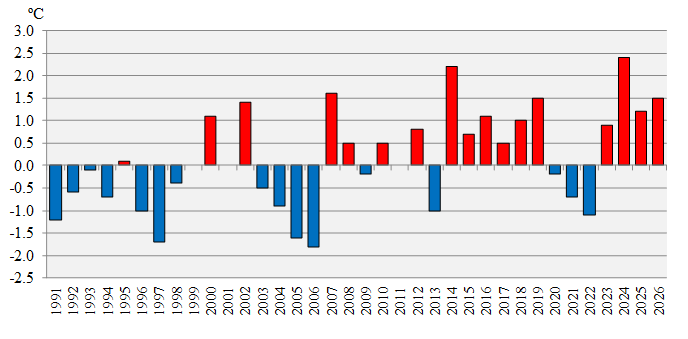
Deviation of the average spring season air temperature
from the climatic norm (+7.3 °C) for the Republic of Belarus
A positive anomaly in seasonal air temperature was observed throughout the entire territory of the country, ranging mainly from 1.1 °C to 1.7 °C.
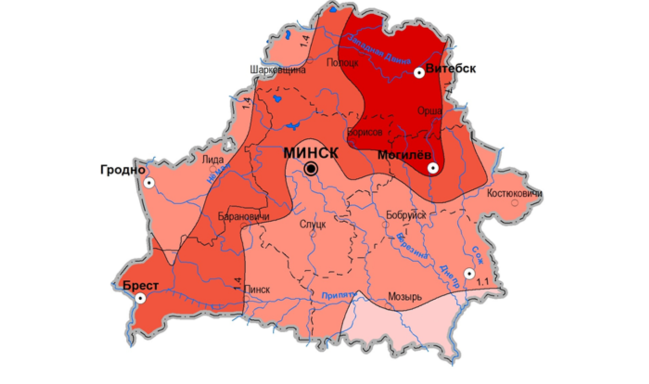
Deviation (°C) of the average spring season air
temperature from the climatic norm across the territory of Belarus
The largest positive deviations in air temperature from the climatic norm were recorded in the territory of the Vitebsk region (averaging 1.7 °C for the region), while the smallest were recorded in the territory of the Gomel region (averaging 1.1 °C for the region). The average air temperature in the first and last months of spring exceeded the climatic norm, while the April temperature turned out to be below the norm.
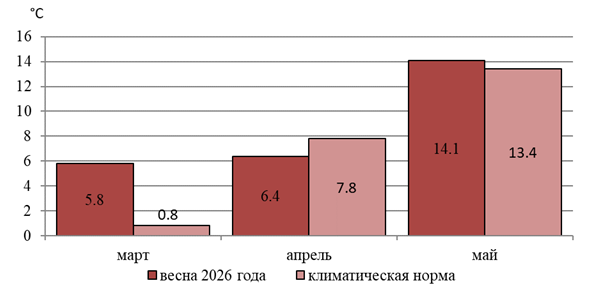
Average air temperature and climatic norm by month
for the spring season of 2026 for the Republic of Belarus
The first spring month turned out to be exceptionally warm and ranked 1st in the ranked series of observations from warmest to coldest, starting from 1945. The average air temperature for Belarus was +5.8 °C, which is 5.0 °C above the climatic norm. At 90% of stations, monthly average air temperature records were broken. Prior to this, the warmest March was observed in 2007 and 2025, with an average monthly air temperature of +5.2 °C.
The maximum air temperature was reached during the day on March 31 at the Kostyukovichi station, reaching +20.0 °C. The minimum air temperature for the month was recorded at the Klichev station on March 8, reaching -9.2 °C.
The transition of the average daily air temperature above 0 °C (the beginning of climatic spring) occurred as early as the third decade of February. The stable transition above 5 °C (the beginning of the growing season) occurred over most of the country at record early dates – March 8-11 (2-4 weeks earlier than usual).
In March, intense heat waves lasting from 5 to 28 days (Mogilev, Slavgorod) were observed across the republic. Despite the very warm weather, absolute March maximum air temperatures were not exceeded, but daily records were broken at a number of stations.
The average air temperature for Belarus for April 2026 was +6.4 °C, which is 1.4 °C below the climatic norm. Such a cold April (or colder) occurs in Belarus approximately once every 4 years. The coldest April in the post-war period was April 1955, with an average monthly temperature of +2.5 °C.
In April, the rise in temperature typically progresses from the beginning to the end of the month. However, this April, the third decade was the coldest, with a negative anomaly of 4.6 °C. The minimum air temperature for the month was recorded at the Drogichin station on April 29, reaching -5.2 °C. The maximum air temperature for the month was observed in the warm first decade – at the Vasilevichi station on April 1, reaching +19.6 °C.
The average air temperature for Belarus for May 2026 was +14.1 °C, which is 0.7 °C above the climatic norm. Starting from 1945, such a high temperature (or higher) in May occurs on average once every 3 years. The warmest May was observed in 2018, when the average monthly air temperature was +16.9 °C.
The maximum air temperature was reached on May 21 at the Slavgorod and Zhlobin stations, reaching +31.0 °C. The minimum air temperature for the month was recorded at the Bragin station on May 2, reaching -2.3 °C. Frosts in the first half of May are considered a typical phenomenon, with their frequency of occurrence in the air being 50-70%.
The stable transition of the average daily air temperature above 10 °C occurred everywhere on May 1-3 – in the northern regions at dates close to normal, and in the rest of the country 5-10 days later than normal.
Over the spring, an average of 99 mm of precipitation fell across the country, which is 71% of the climatic norm for the season. Over most of the country, precipitation amounted to 50-100% of the norm.
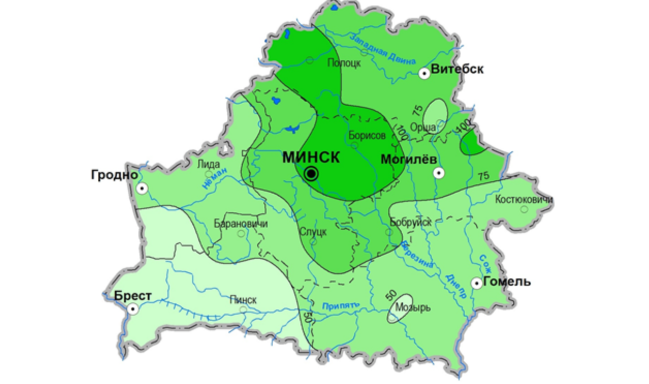
Deviation (%) of the monthly precipitation sum for
the spring season from the climatic norm across the territory of Belarus
At the regional level, the highest amount of precipitation was recorded in the Minsk region (131 mm or 93% of the seasonal norm). The lowest was in the Brest region (59 mm or 43% of the norm).
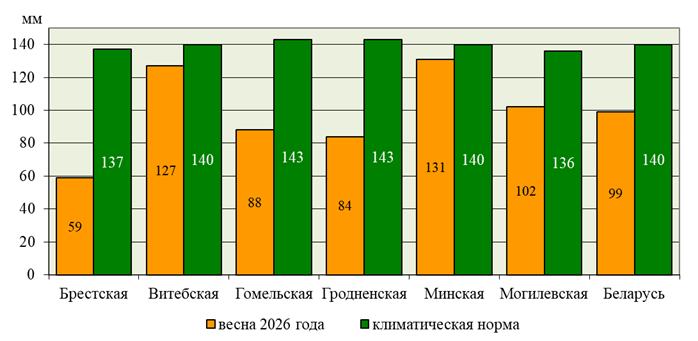
Precipitation amount for the spring season of 2026 and
the climatic norm by regions and by the territory of Belarus
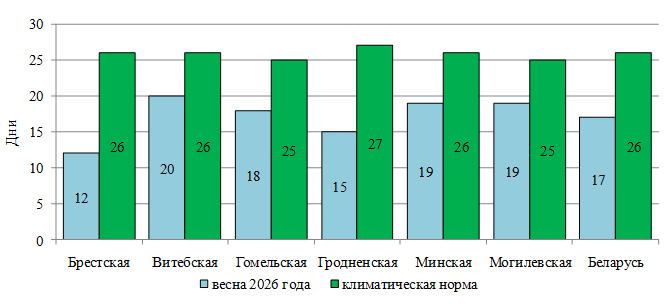
Number of days with precipitation of 0.1 mm or more for spring 2026 and
the climatic norm by regions and by the territory of Belarus
Throughout the spring season, precipitation across the territory of Belarus was unevenly distributed, with periods of both precipitation deficit and excessive moisture observed.
March 2026 was anomalously dry and ranked 1st in the ranked series of observations from driest to wettest, starting from 1945. Prior to this, the driest March in the post-war period was March 2022 (6.0 mm). In the first spring month of this year, 3.8 mm of precipitation fell, which amounted to 10% of the climatic norm. At all observation points in the eastern half of the republic, absolute monthly precipitation minima were broken. At the Zhlobin and Slavgorod stations, no precipitation was observed during the month.
In April, an average of 24 mm of precipitation fell across the republic, which amounted to 61% of the climatic norm. Such a dry April occurs approximately once every 6-7 years. The driest April was in 2019, with a monthly precipitation sum of only 7 mm.
In May, an average of 71 mm of precipitation fell across the republic, which amounted to 112% of the climatic norm. A May with such a high amount (or higher) of precipitation is observed in Belarus approximately once every three years. Precipitation was extremely unevenly distributed across the country. At individual weather stations in the north and center of the country, twice the monthly norm fell. Meanwhile, in the southwest, the amount of precipitation for the month did not even reach 70% of the norm. The monthly maximum precipitation for May was exceeded at the Minsk station – 143 mm (the previous record was 132 mm in 1984). At the Berezino station, the daily precipitation record was broken: 52 mm fell on May 8 (the previous record was 47 mm in 1973).
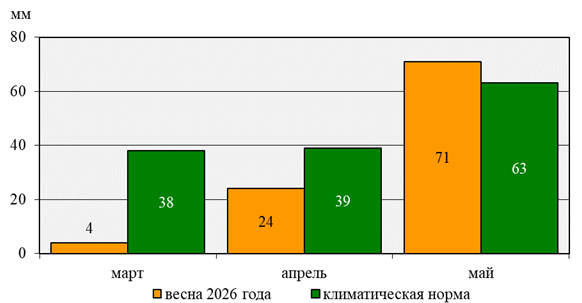
Precipitation amount and climatic norm by month for the spring season of 2026
During the season, precipitation fell mainly as rain, and in March and sometimes April also as sleet and snow. The snow cover completely disappeared in the last decade of March. At the beginning of spring, icy conditions were noted in some areas. Throughout the season, fogs were observed; in April and May, thunderstorms occurred, locally accompanied by hail up to 16 mm in diameter (Borisov). Rains varied in intensity, locally heavy, and in some areas torrential. An increase in wind speed with gusts of 15 m/s or more was noted, locally reaching the criterion of a hazardous hydrometeorological phenomenon (25 m/s or more). At the Slavgorod station, wind gusts of 25 m/s or more were recorded twice during the spring: on April 23, the wind speed was 29 m/s, and on May 27, the wind speed was 26 m/s.
When using the information a reference to Belhydromet is obligatory
Specialized sites
Informational resources
 State Symbols of the Republic of Belarus
 The National Legal Internet Portal of the Republic of Belarus
 The Ministry of Natural Resources and Environmental Protection of the Republic of Belarus
 The Official Internet Portal of the President of the Republic of Belarus
 The Portal for Rating Assessment of the Quality of Services Provided by Organizations in the Republic of Belarus
 The CIS Interstate Council for Hydrometeorology (CIS ICH)
 Information Analysis Portal of the Union State
 The Union State Committee on Hydrometeorology and Environmental Contamination Monitoring
 The Internet Portal "The Youth of Belarus"