

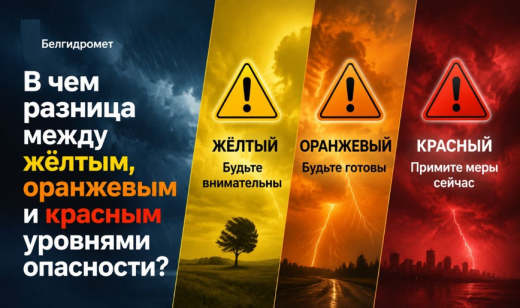
Belarus uses a 4-level color-coded scale (green, yellow, orange, red) to assess weather hazards. It helps to quickly understand how serious the threat is.
Green: the weather is not hazardous.
Yellow: the weather is potentially hazardous. In some areas (less than 30% of the territory), adverse hydrometeorological phenomena are expected: heavy precipitation, thunderstorms, strong gusty winds, extreme heat/frost, and others. These phenomena are typical for Belarus but may be dangerous for certain types of activities.
Orange: the weather poses a real danger. Over most of the country (30% or more of the territory), adverse phenomena are expected, and in some areas (less than 30% of the territory), hazardous hydrometeorological phenomena (very heavy precipitation, very strong winds, large hail, extreme heat/frost, and others) are expected. There is a threat of significant material damage and possible casualties.
Red: the weather is very dangerous. Over most of the territory, hazardous hydrometeorological phenomena are expected, which pose a threat to public safety and may cause serious material damage and multiple casualties.
When using the information a reference to Belhydromet is obligatory
© Belhydromet, 2016-2026