

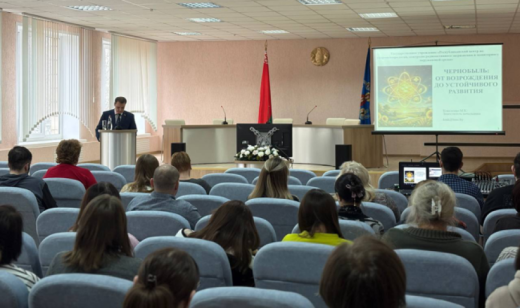
On April 17, Belhydromet held a Unified Information Day on the theme "Chernobyl – From Revival to Sustainable Development."
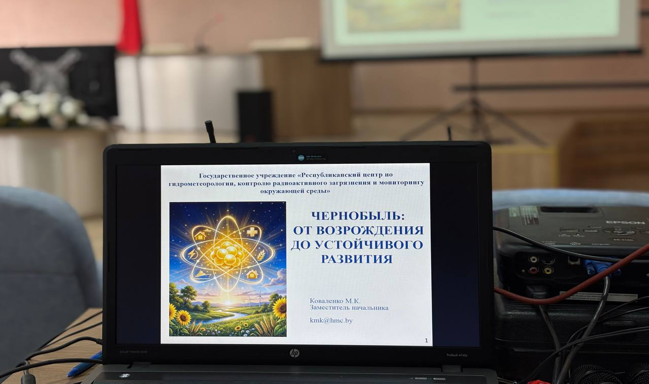
The event was dedicated to discussing progress in overcoming the consequences of the Chernobyl nuclear power plant accident and the prospects for sustainable development of the affected territories.
The speaker was Mikhail Kovalenko, Deputy Head of Belhydromet. In his address, he placed particular emphasis on Belhydromet's contribution to mitigating the consequences of the accident and on the development of the radiation monitoring network.
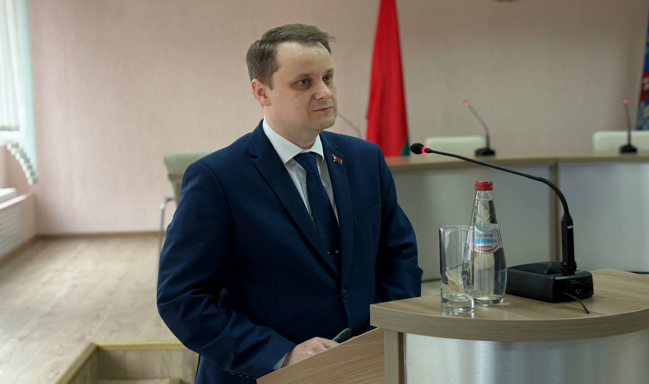
Mikhail Kovalenko spoke in detail about the institution's many years of work: Belhydromet specialists were among the first to begin measuring background radiation, which made it possible to quickly assess the scale of contamination and produce initial maps of the radiation situation. For nearly four decades, Belhydromet has been conducting continuous observations of the radiation situation across the entire territory of the country, paying special attention to areas affected by the Chernobyl accident. The institution's employees carry out measurements of radionuclide content in the atmospheric air and also study migration processes in the soil. The data obtained serve as the basis for developing remediation measures. Belhydromet's data are used both in decisions on classifying territories as zones of radioactive contamination and in decisions on returning territories to economic use.
A separate part of the address was devoted to the evolution of the radiation monitoring system: over the years, an extensive network of radiation monitoring points has been established, covering all regions of Belarus, including zones affected by nuclear power plants in neighboring states, as well as the area around the Belarusian NPP. Modern automated control systems have been introduced, allowing real‑time monitoring of gamma radiation levels and rapid response to changes in the radiation situation. Analytical laboratories have been modernized, equipped with high‑precision instruments for determining radionuclide content in the environment (air, water, soil). Information systems have been developed for collecting, processing, and visualizing radiation monitoring data, providing access to up‑to‑date information for specialists from relevant agencies and for the public.
In conclusion, Mikhail Kovalenko emphasized:
"The development of the radiation monitoring network is not merely a technical improvement. It is a guarantee of the safety of our citizens, the foundation for informed decisions in the fields of ecology, agriculture, and territorial planning. Thanks to the many years of work by Belhydromet specialists, we can confidently speak of the gradual revival of the affected territories and their transition to sustainable development."
© Belhydromet, 2016-2026