

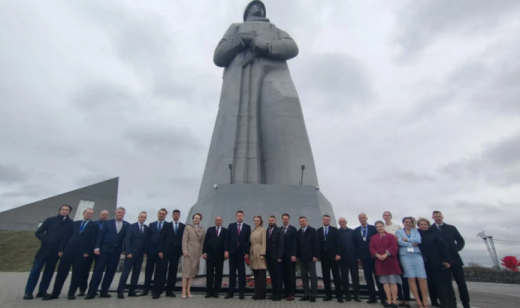
Today, the 81st session of the Joint Board of the Union State Committee on Hydrometeorology and Environmental Pollution Monitoring concluded. The delegations of the two countries reviewed cooperation issues and discussed future plans.
The key topics were:
- the launch of a new Union State program on radiation monitoring;
- the work of Belarusian polar explorers in Antarctica with support from the Russian side;
- the use of artificial intelligence for processing meteorological data.
For more details, watch the report by Arctic TV!
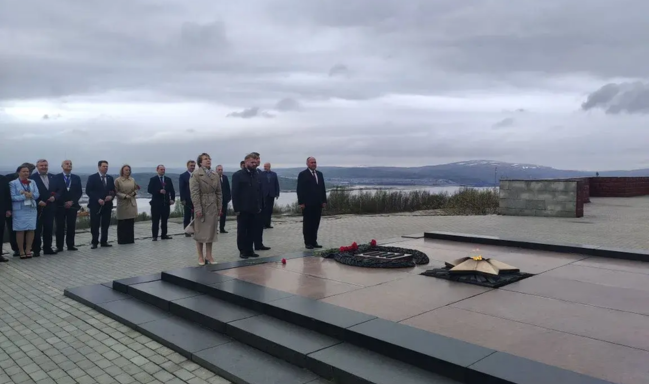
As part the event's business program, participants laid flowers at the memorial "To the Defenders of the Soviet Arctic during the Great Patriotic War" ("Alyosha").
The monument to the heroic defenders was erected in 1974 by sculptor Isaac Brodsky and architect Igor Pokrovsky to mark the 30th anniversary of the defeat of the fascist army in the Arctic. Since its opening, residents of Murmansk have affectionately called it the "Murmansk Alyosha." The main figure of the monument is that of an unnamed warrior, a soldier. The height of the memorial is 42.5 meters. The soldier's figure, standing 35.5 meters tall, rises from a seven-meter pedestal.
The memorial complex also includes the "Eternal Flame" podium, an alley of hero cities, a memorial to home front workers, and anti-aircraft guns that were used during the Great Patriotic War. According to Arctic TV, from May 29, 2026, the memorial will be closed for extensive restoration.
The delegation visited the nuclear-powered icebreaker "Lenin" – the world's first civilian vessel with a nuclear power plant, which has become a symbol of Russia's scientific and technological progress.
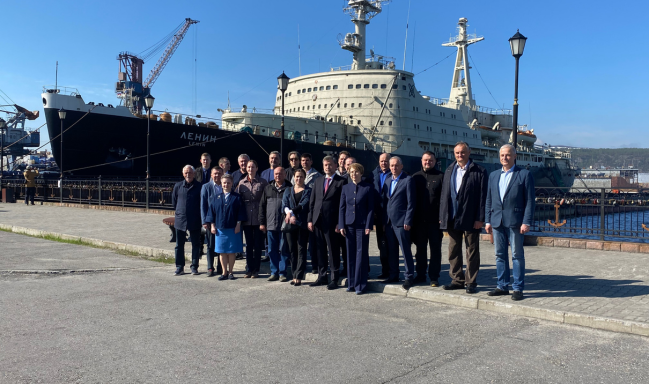
The icebreaker, built through the efforts of over 500 enterprises and institutions of the USSR, was commissioned on December 3, 1959. In 2009, it was moored in the center of Murmansk near the sea terminal, quickly becoming a "calling card" of the Murmansk region.
In addition, the session participants visited the Federal State Budgetary Institution "Murmansk Administration for Hydrometeorology and Environmental Monitoring," which ensures hydrometeorological safety in the Arctic region, as well as the institution's history museum, which reflects years of experience in observing the climate and natural phenomena of the Kola Arctic.
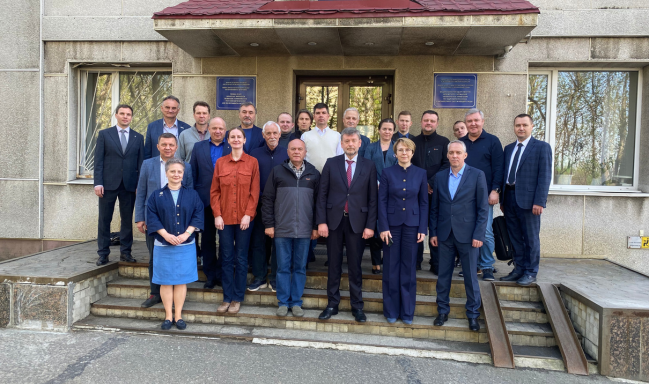
Familiarization with the work of Murmansk's hydrometeorologists and the history of Arctic exploration allowed the session participants not only to broaden their professional horizons but also to strengthen mutual understanding within the framework of bilateral cooperation between the hydrometeorological services of the Republic of Belarus and the Russian Federation.
© Belhydromet, 2016-2026