

The average monthly air temperature in January was -10.3 °C, which is 6.2 °C below the climatic norm. Before the warming period that began in the late 1980s, a January of this level of coldness or colder occurred approximately once every 6 years. Since 1989, such a cold January has been recorded for the second time, after January 2010 when the air temperature was -11.5 °C. The coldest January in the post-war period was in 1987 (-16.3 °C).
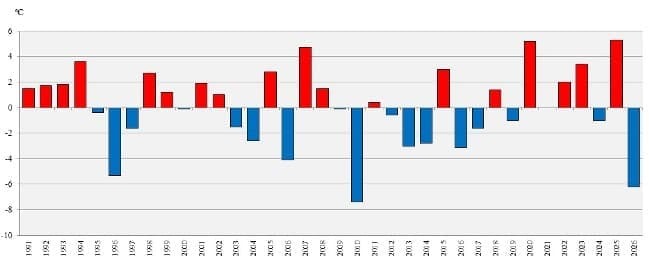
Deviation of the average January air temperature for the period 1991-2026
from the climatic norm (-4.1°C)
A negative air temperature anomaly spread across the entire territory of Belarus and ranged from 5.5 to 6.5 °C.
By region, the largest negative deviations of air temperature from the climatic norm were noted in the Minsk and Mogilev regions (on average 6.4 °C for each region), and the smallest – in the Brest region (5.8 °C).
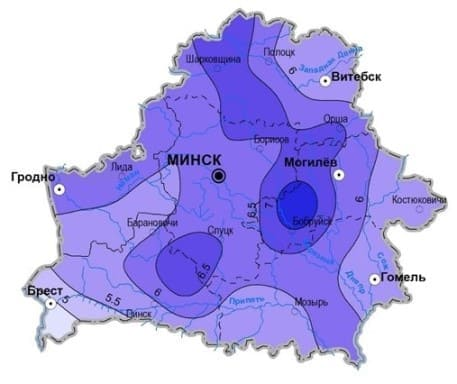
Deviation (°C) of the average air temperature in January 2026 from
the climatic norm across the territory of Belarus
All three ten-day periods of the month were cold. The coldest was the second ten-day period, with a mean ten-day temperature 12.0 °C below the norm. It has not been this cold in the second ten-day period of January for 40 years, specifically since 1987. The temperatures of the first and third ten-day periods were 2.0 °C and 4.7 °C below the norm, respectively.
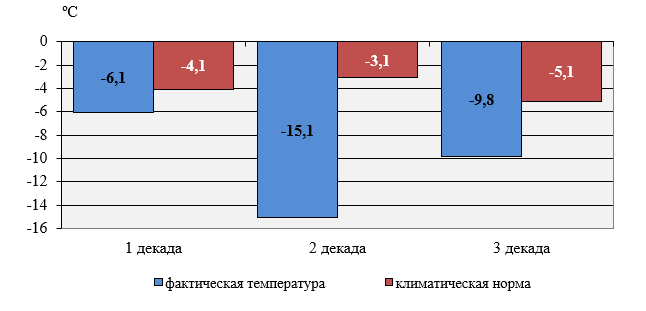
Average air temperature and climatic norm by ten-day periods of
January 2026 across the territory of Belarus
The air temperature during daytime hours was mainly negative and predominantly ranged from -2 °C to -12 °C. However, on separate days at the beginning and end of the month, thawing weather was observed, and the air temperature reached its maximum value (+2.3 °C) on January 3 at the Lelchitsy station and on January 28 at the Zhitkovichi station.
The air temperature at night was mainly within -10 °C to -20 °C, and in some places during the coldest nights, it dropped to -25 °C and lower. The minimum air temperature for the month was recorded at the Bolshoy Mezhnik station on January 14 and was -29.7 °C.
During the month, an average of 49 mm of precipitation fell across the republic, which constitutes 120% of the climatic norm. Precipitation was distributed unevenly across the country, with 90-150% of the monthly norm falling over most of the territory. January daily precipitation records were updated at the following observation points: Orsha – 26 mm (19 mm in 1931), Berezino – 28 mm (25 mm in 2016), Oshmyany – 22 mm (20 mm in 2008), Mstislavl – 18 mm (15 mm in 2022), Mogilev – 37 mm (24 mm in 1958), Slavgorod – 21 mm (17.1 mm in 2024), Zhlobin – 28 mm (20 mm in 2021).
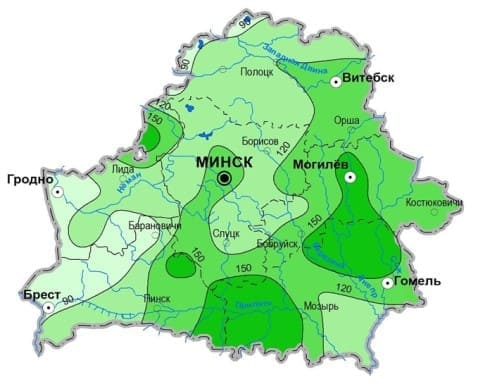
Deviation (%) of the monthly recipitation total for January 2026
from the climatic norm across the territory of Belarus
By region, the most precipitation was recorded in the territory of the Gomel Region – an average of 57 mm or 147% of the norm. The least – in the territory of the Brest Region – 38 mm or 101% of the norm.
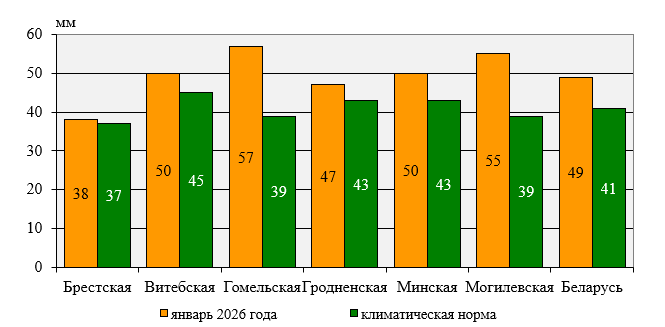
Precipitation amount for January 2026 and climatic norm by
regions and across the territory of Belarus
Throughout the month, precipitation fell unevenly. Excessive moisture was noted in the first ten-day period (253% of the norm fell). A deficit of precipitation was noted in the second ten-day period (16% of the norm fell). In the third ten-day period, an average of 89% of the norm fell across the country.
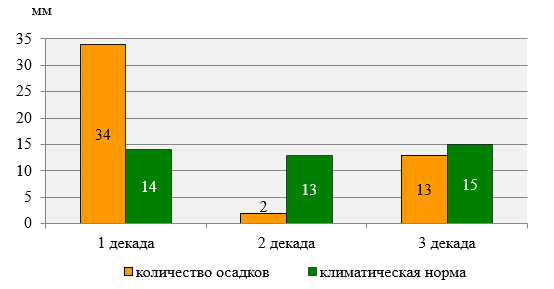
Precipitation amount and climatic norm by ten-day periods of
January 2026 across the territory of Belarus
Precipitation fell in the form of snow and wet snow. Snow cover lay throughout the entire month. By the last day of the month, the snow depth ranged from 2 cm in Kobrin to 46 cm in Vitebsk.
Throughout the month, fog, icing events were observed, and in some areas, a blizzard was observed. On January 8 and 9, heavy snowfall was noted across the country; at some observation points, a hazardous phenomenon was recorded – very heavy snow with a precipitation amount of up to 27 mm (within 12 hours or less). On January 29, a hazardous phenomenon was observed in the area of the Zhitkovichi Meteorological Station: heavy wet snow accretion with a diameter of 88 mm.
In some areas, wind speed increased with gusts up to 15 m/s and more. The maximum wind speed for the ten-day period was recorded at the Oshmyany station on January 9 (19 m/s).
When using the information a reference to Belhydromet is obligatory
© Belhydromet, 2016-2026