

The average air temperature in Belarus for February was -7.4°C, which is 3.9°C below the climatic norm. Such or lower air temperatures in February occur approximately once every 5 years. The coldest February in the last 80 years was in 1956, with an average monthly air temperature of -14.9°C.
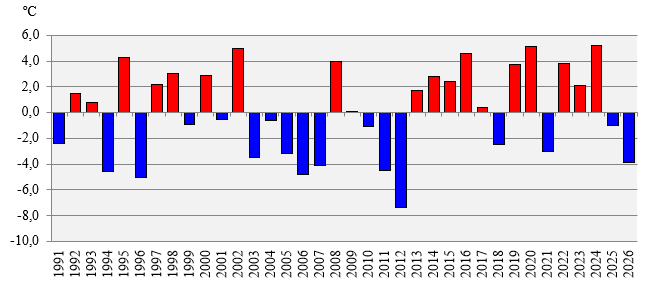
Deviation of the average February air temperature for the period 1991-2026
from the climatic norm (-3.5°C)
The negative air temperature anomaly spread throughout the territory of Belarus, and was mainly in the range of 3.2 to 4.4 °C.
By region the largest negative temperature deviations from the climatic norm were recorded in the Vitebsk region (average for the region 4.3°C), and the smallest in the Brest region (average for the region 3.3°C).
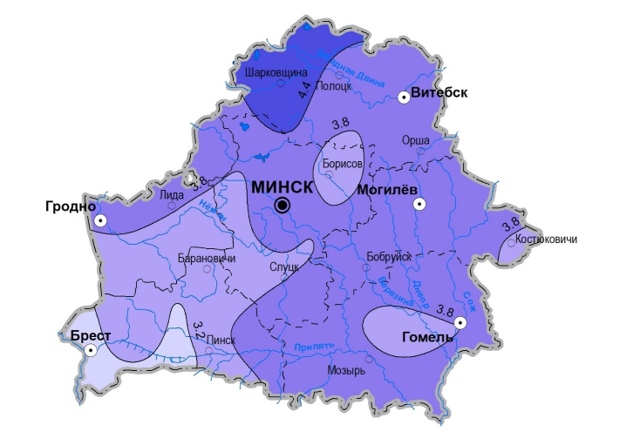
Deviation (°C) of the average air temperature in February 2026
from the climatic norm in Belarus
The first decade of the month was very cold with an average air temperature in Belarus of -13.0°C, which is 8.6°C below the climatic norm. The average air temperature in the second decade was also below the climatic norm, by 2.7°C. The third decade was 0.7°C above the norm.
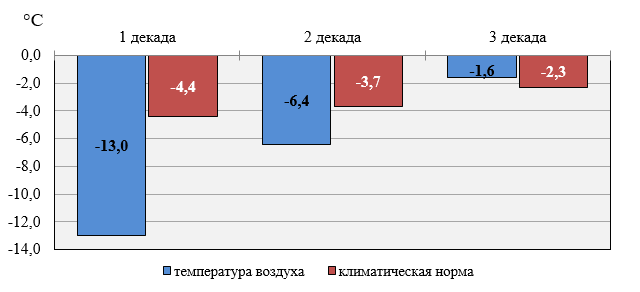
Average air temperature and climatic norm
for decades of February 2026 in Belarus
During the daytime for most of the month, frosty weather prevailed with temperatures of -5 to -10°C. On certain days at the beginning of the month, temperatures dropped to -11 to -19°C and below. At the same time, there were also thaw periods when the air temperature exceeded zero degrees and on the last day of the month, it rose to higher values. The maximum daytime temperature for the month was recorded at Grodno station on February 28, reaching +13.5°C.
Nighttime temperatures on most days of the month were mainly in the range of -10 to -18°C. On certain days, they dropped to -20 to -25°C and locally to -30°C. The minimum air temperature was recorded on February 2 at Polesskaya station (-31.1°C).
During the month, an average of 24 mm of precipitation fell in the republic, which amounted to 63% of the climatic norm. Such dry conditions in February occur approximately once every 4-5 years. The driest February was in 1972, when only 8 mm of precipitation fell during the month. Over most of the country, 40-70% of the normal precipitation fell.
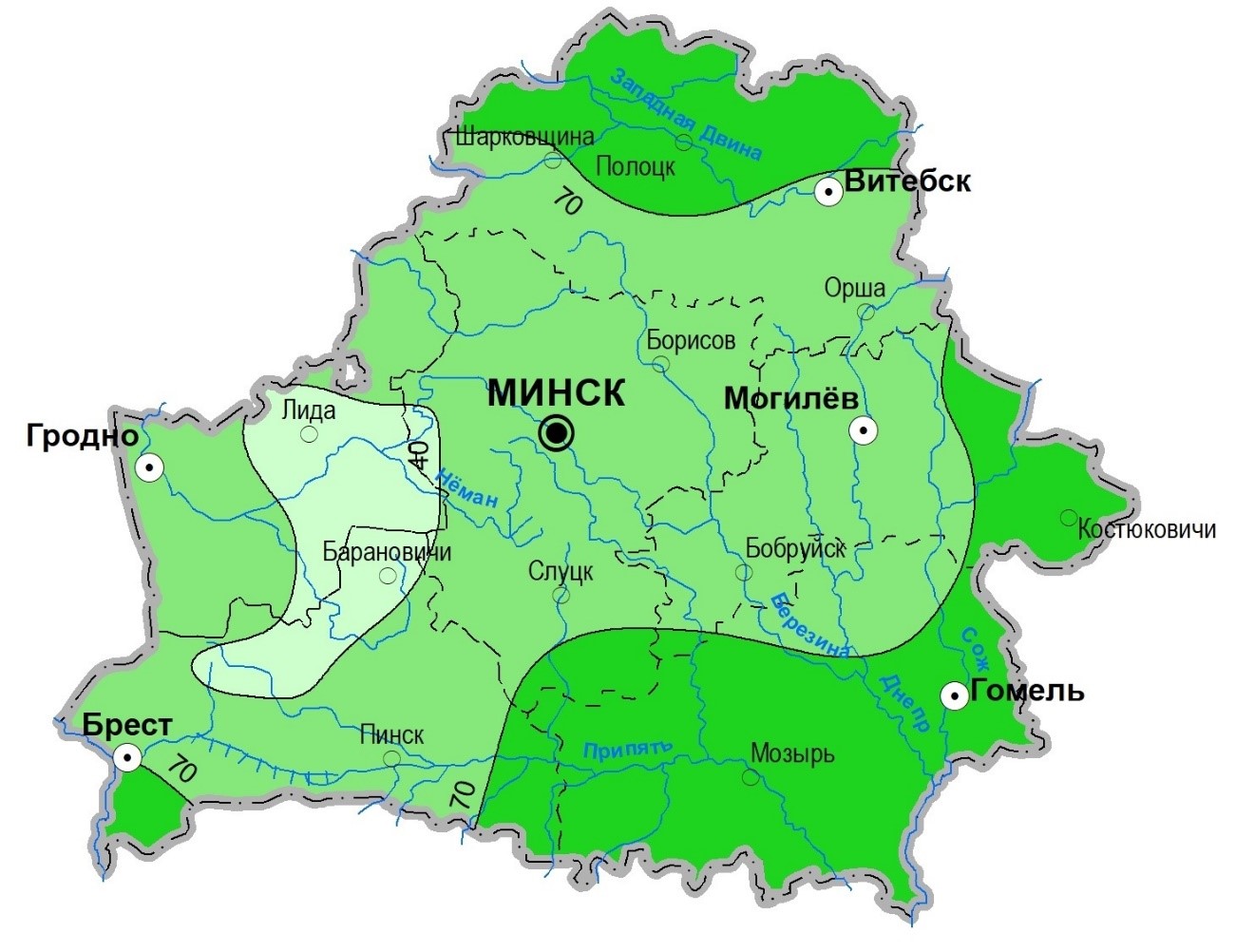
Deviation (%) of the monthly precipitation for February 2026
from the climatic norm in Belarus
By region, the highest amount of precipitation was recorded in the Gomel region – averaging 32 mm or 83% of the norm. The least amount fell in the Brest region – 17 mm (49%).
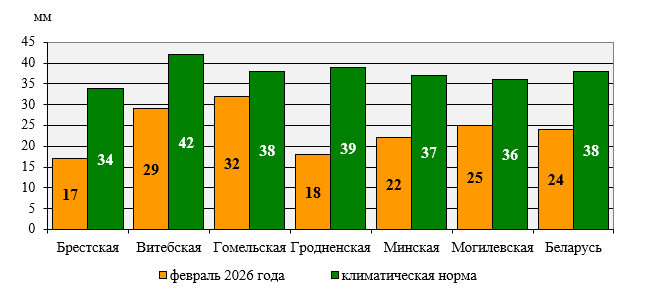
Precipitation amount for February 2026 and climatic norm
by region and the territory of Belarus
During all three decades of the month, there was a shortage of precipitation.
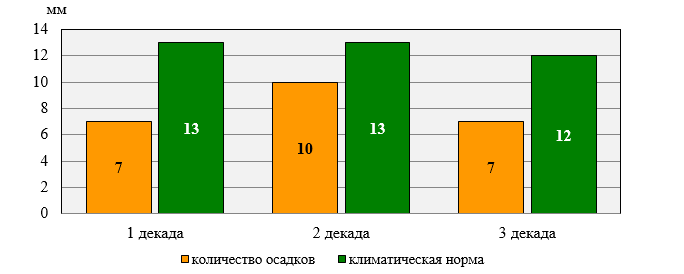
Precipitation amount and climatic norm
decades of February 2026 on the territory of Belarus
Precipitation fell as snow, sleet, and rain. Throughout the month, snow cover remained in most parts of the country, except for the extreme southwestern regions, where it melted by the middle of the third ten-day period. Snow cover across the republic was uneven, and on the last day of the month, its depth ranged from 1 cm (Ivatsevichi) to 46 cm (Kostyukovichi, Verkhnedvinsk). Snow cover was absent in the extreme southwest of the country. The maximum snow depth was recorded at Verkhnedvinsk station on February 14-17, reaching 56 cm.
During the month, ice glaze phenomena were observed; fogs and wet snow accretion occurred on certain days. During the month, weak and moderate winds prevailed, with gusty wind speeds increasing to 15 m/s or more in some places. The maximum wind speed for the month was recorded at Oshmyany station on February 21 and at Dokshitsy station on February 27, reaching 16 m/s.
When using the information a reference to Belhydromet is obligatory
© Belhydromet, 2016-2026