

The average air temperature in Belarus for August 2026 was +18.4°C, which is 0.4°C above the climatic norm. Such and higher average monthly air temperatures in August are recorded approximately once every 2–3 years. The hottest August was in 2010, with an average monthly temperature of +20.8°C; the coldest was in 1987 (+14.3°C).
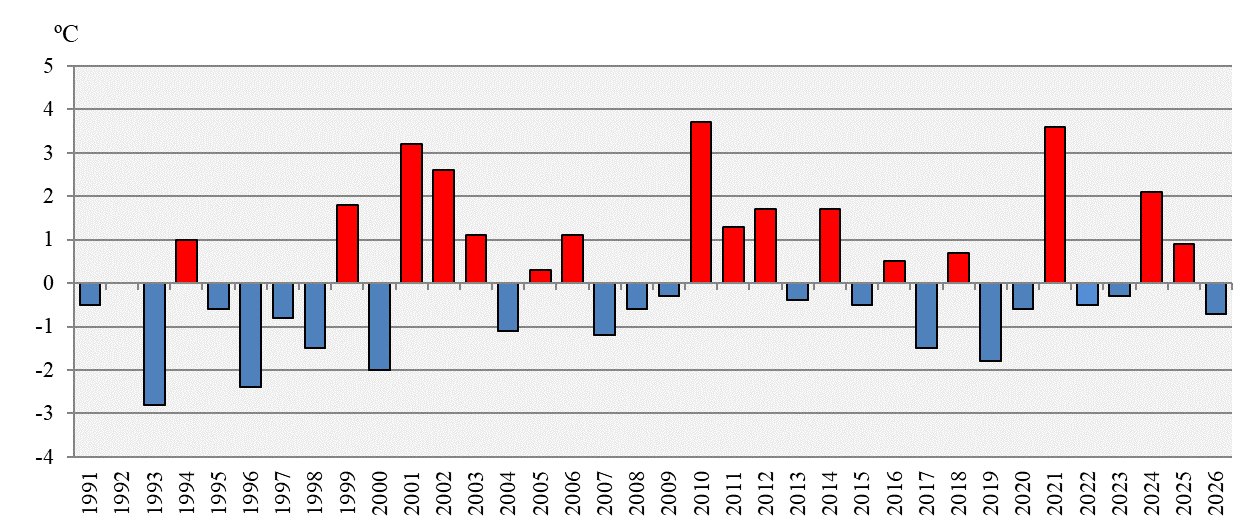
Deviation of the average air temperature in August for the period
1991–2026 from the climatic norm (+18.0°C)
A positive air temperature anomaly spread across almost the entire territory of the country. In terms of regions, the highest values of positive deviations of air temperature from the climatic norm were recorded in the Gomel region (1.0°C); in the Vitebsk and Minsk regions, the deviations were the smallest (on average 0.1°C for each region).
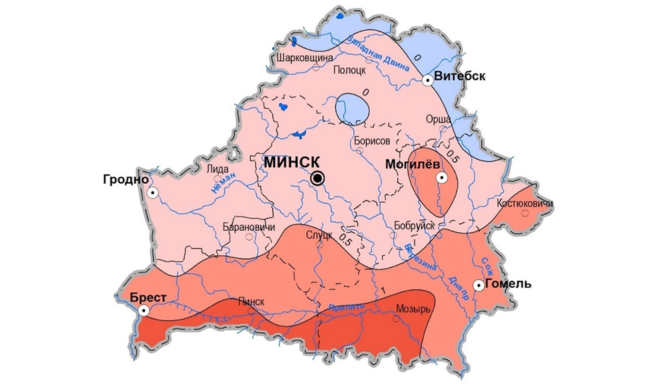
Deviation (°C) of the average air temperature in August
from the climatic norm across the territory of Belarus
The first ten-day period was the warmest, with an average ten-day air temperature 2.0°C above the climatic norm; the temperature of the second ten-day period was 0.8°C below the norm; in the third ten-day period, the air temperature corresponded to the norm.
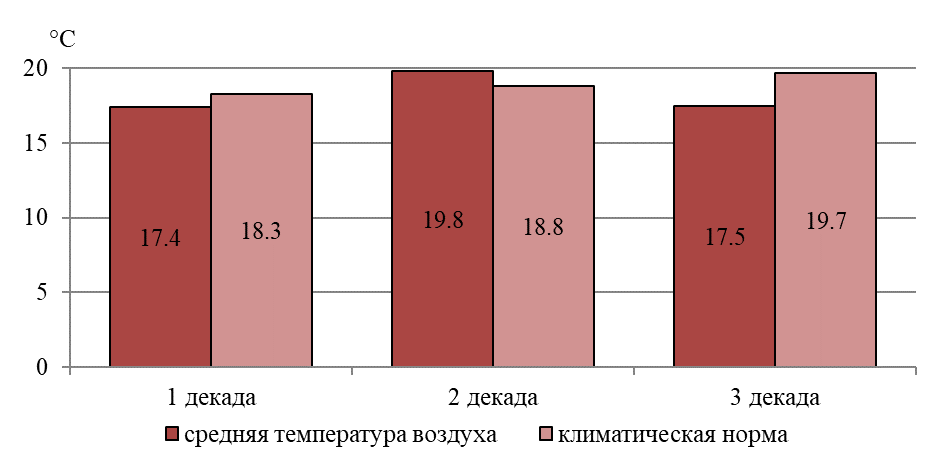
Average air temperature and climatic norm by ten-day periods
of August 2026 across the territory of Belarus
Daytime temperatures in August were highly contrasting. During hot periods, mainly in the first half of the month, daytime air temperatures exceeded +25°C, rising on some days to +30°C and above, while in the south of the republic the air temperature reached the criterion of a dangerous hydrometeorological phenomenon (+35°C and above). On other days, the air temperature remained within +19 to +24°C.
The maximum value (+40.3°C) was reached during the day on 6 August at the Mozyr station. In more than 140 years of systematic meteorological observations, the air temperature in August had never before reached such a value. The previous record was recorded in August 2010 (+38.9°C in Gomel). Also, at individual stations in the Brest and Gomel regions, monthly air temperature records were broken: Pruzhany +36.0°C (previous record +35.9°C in 2015), Polesskaya +37.8°C (previous record +35.8°C in 1992), Brest +37.6°C (previous record +36.7°C in 2015), Pinsk +38.3°C (previous record +36.3°C in 1905), Vasilevichi +38.6°C (previous record +38.0°C in 1946), Zhitkovichi +38.9°C (previous record +36.5°C in 2008), Mozyr +40.3°C (previous record +36.4°C in 2010), Lelchitsy +39.6°C (previous record +38.2°C in 2010). The Vysokoye station repeated the 2015 record (+36.5°C).
Nights were mostly warm, with temperatures of +10 to +20°C; only on certain days did the air temperature drop below +10°C. The minimum air temperature was recorded at the Polesskaya station on 26 August and amounted to +2.6°C.
Over the month, on average across the republic, 52 mm of precipitation fell, which constituted 82% of the climatic norm. Precipitation was distributed unevenly across the country.
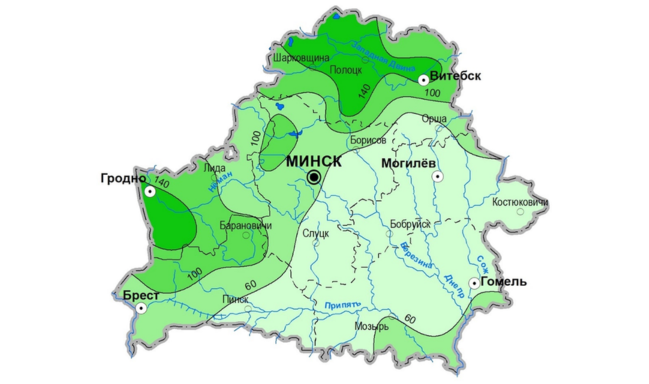
Deviation (%) of the monthly precipitation total for August
from the climatic norm across the territory of Belarus
A significant precipitation deficit was experienced in the Mogilev and Gomel regions, where 28 mm of precipitation fell over the month in each, or 45% and 48% of the climatic norm, respectively. The most precipitation fell in the Vitebsk region – on average 84 mm for the region (118% of the norm).
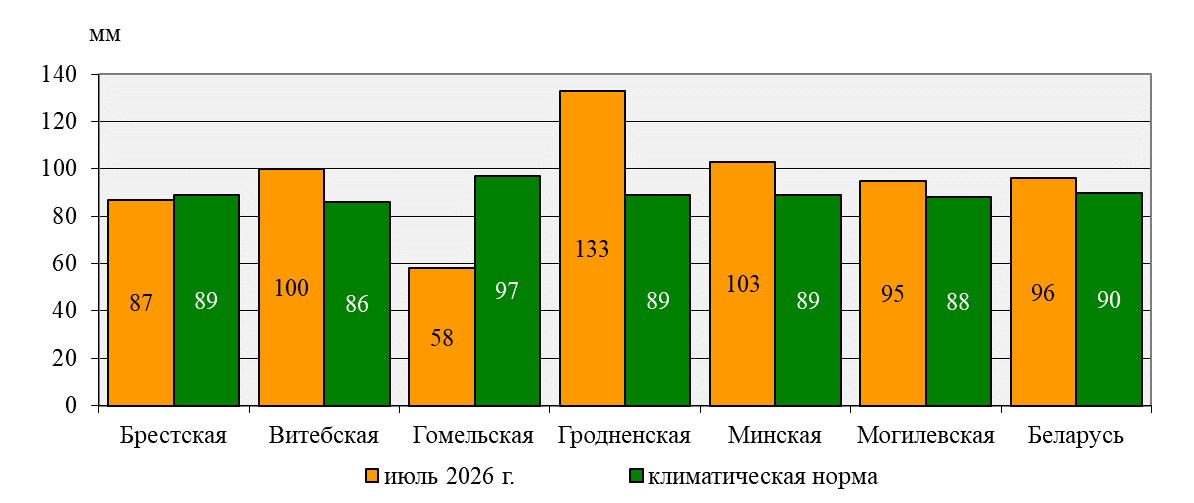
Precipitation amount for August 2026 and climatic norm
by regions and across the territory of Belarus
In the first and third ten-day periods, there was a shortage of precipitation: 66% and 54% of the ten-day norm fell, respectively. In the second ten-day period of the month, there was an excess of precipitation – 133% of the ten-day norm.
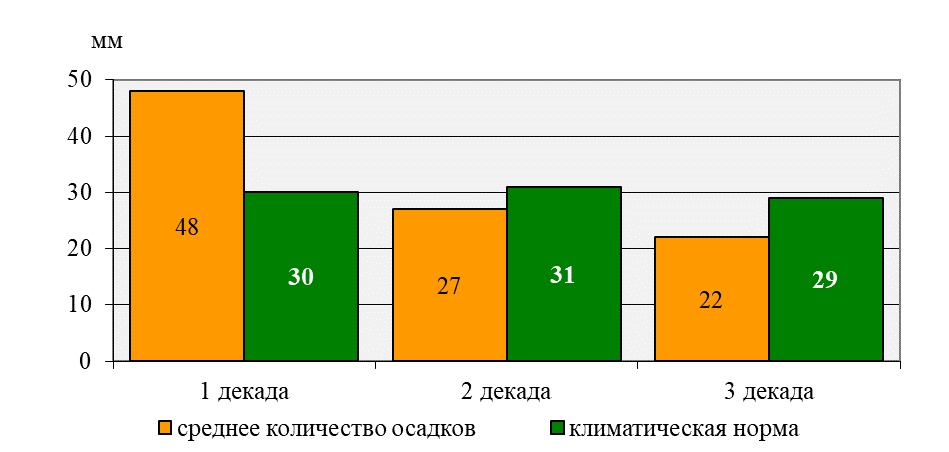
Precipitation amount and climatic norm by ten-day periods
of August 2026 across the territory of Belarus
The rains were predominantly of a showery nature, accompanied by thunderstorms, and hail up to 18 mm in diameter was recorded (Grodno). On 18 August, a dangerous phenomenon was registered at the Svisloch AMS: very heavy rain with a precipitation amount of 57.3 mm. In certain areas of the country, fog was observed. There was an increase in wind speed with gusts up to 15 m/s and more; in places, the wind speed reached the criterion of a dangerous hydrometeorological phenomenon (25 m/s and above). The maximum wind speed for the month was recorded on 7 August at the Ivye AMS (29 m/s).
When using the information a reference to Belhydromet is obligatory
© Belhydromet, 2016-2026